


22 Mar Taking Web Presence Seriously by Sean Griffin
As a small business in Southern Dutchess, let alone anywhere, it would be understandable to want to dismiss a couple bad Yelp or Google reviews. There will always be customers, or even non-customers, you can’t make them happy. This blog is to inform you that you need to take web reviews seriously, and it will assist you in how to counter a bad review.
Cornerstone Services is a Chamber member and we are a small web and direct mail communications firm in the Hudson Valley. I grew up in Dutchess and like to think that we have only 1 or 2 degrees of separation from most of the other local businesses.
My naïve comfort level was that if there’s a problem, we can always work it out because that’s what good people do, right? However, our firm, Cornerstone received an admittedly scathingly bad review in early January 2024 which came with a customer promise that “we’ll never use you again”. Ow. Ouch. If that wasn’t bad enough, we were faulted for perceived rudeness and for “demanding payment” soon after we did a (rush) design, print and mailing job for a local non-profit in December 2023. So, if you’re still reading, hopefully you haven’t yet spray-painted us with a big red “X”.
For better or for worse, online reviews matter and there’s a way for Pawling Chamber members to counter reviews and correct them. I’m hoping our experience could be of some use to you. As a fellow Chamber member, I want to share with you how we handled it and why it is important for you to deal with such issues quickly and head-on.
Establish Terms & Conditions and Stick to Them
Initially, I can’t even describe the shock and hurt. It hurts just writing this. We had really clear Terms and Conditions for which we had prior written agreement, and my staff and I stayed late to get a job out the prior week. Yet, we broke our own rules because usually we don’t advance work without getting paid first — none of this mattered for some reason. This is the first thing I could recommend to you – be devastatingly clear about your Terms and Conditions and stick to them. In December 2023, we “ran our own red light” for a local non-profit org that came in mid-December needing to do a rush FYE appeal mailing. (My biggest worry, I confess, is that if I had to do this project again, I might actually do the same thing – I would try to go over-the-top and help). My so-called “helping” backfired here. I broke my own rules, so now we put our Terms and Conditions on our website and link all estimates and invoices to them, as such: “https://crst.net/terms-and-conditions/”.
Try to Work It Out
This sounds like a cliché, but when I read, re-read and re-re-read the review (you get the idea), I eventually realized that there was not going to be a way out. The review was largely patently false, emotionally loaded and peppered with hyperbole even at minor points that were conceivably debatable. At some point, I had to stop perseverating on this and move on. Here, there was going to be no starting point for a reasonable discussion.
Interestingly, the review was accompanied by an email which relayed much of the same information (as well as the promise of a forthcoming and negative online review). I actually took this to be mildly good news because usually, if someone wants to have a relationship with you, they will keep communicating even if in a negative context. Conversely, if a customer doesn’t like you, he or she will just ghost you and walk away. I didn’t respond via email, but I decided to write a return letter within 3 days of seeing that a negative review was left. In the letter, I acknowledged this person’s feelings (this is not an affirmation of guilt, but rather an attempt to show some level of emotional intelligence), but then stated that my own internal findings (again, pointing to reason — we did an internal Kaizen review of the project) did not match her statements about my staff as detailed in the email or the online review. I wished this person goodwill and Godspeed in the future, but I asked specifically and formally for her to take down the negative review.
Please note that mud-slinging will not help here. Mud-slinging is not communicating – it is taking turns, at best, in talking and reinforcing previously held negative beliefs about one another. At worst, verbal retaliation fan the fires of crazy. It is not your job to fix crazy. You can’t counter crazy with more crazy, so make one solid effort to work it out and move on.
If you get a poor review that is more genial than what we received, then you could pick up the phone, make a sincere phone call to the reviewer and say “hey, I can see you are upset – please tell me what would it take to make you happy?” Sometimes, people are caught off guard by the expression of empathy and genuine concern that may have previously been viewed as non-existent. For Cornerstone, in this one instance, it was pretty clear that a foothold for rapport was not going to be possible (I tried – I even stopped by the organizational office to be turned away).
Negative Review Offset
Once you have made either telephonic, in person or written contact (note: I don’t consider email to qualify for genuine communication), and you can’t work out getting the review removed, then you ought to respond. Responding is different than reacting. Take a couple days, then respond. We waited 30 days for our ne’er-do-well reviewer to take down the bad review before deciding to respond. I’m glad I waited. Reacting without care, concern or reason would make us (or you) look just as bad. There is high ground here. Take it.
To be clear, we *had* to respond because reviews really do matter! Unresponded reviews can have a long-term, damaging effect. You can’t un-review reviews even if some customers are emotionally unstable. Yelp.com, for example, is a “a crowd-sourced local business review and social networking site” that has very specific review criteria. Reviews can only be taken down, and not even quickly, if they break Yelp’s stated terms and conditions for communal engagement.
Even if all you say is “We’re sorry to hear about your unfortunate experience and hope that you will reconsider in the future”, this is better than saying nothing. Saying nothing does actually say something – it says that you don’t care. Responding, on the other hand, shows that you’re human, you’re awake, and not completely tone-deaf to people’s concerns even if their comments come from Planet Psycho. Most people know that the world is as full of wackadoodles as it is filled with good people. Have faith — trust that good and reasonable people will find you.
Quick side story: we did marketing for a large regional propane company in the Hudson Valley, and in one of our meetings, in reviewing the client’s web presence (standard MO for us if we do direct mail or work on a website), I noted that there were a lot of negative online review (and I mean a LOT of negative reviews). The general manager said that he “didn’t care about them [the Google reviews]” and he walked me through many of the reviews, relaying the story of select reviewers because he “knew the back stories”. Perhaps these even sound familiar to you in the Pawling area: “that guy never pays his bills, so we stopped delivering….”; “twice she wasn’t home when the truck showed up to fix her furnace… then blamed us saying we never came!”; and, “this guy actually gave us positive feedback on Facebook, so I don’t know what his problem is?!” I still think he should have addressed each review, but it’s not my company. At the end of the day, reviews matter, so if you do nothing else, simply respond to each one.
Outweighing Reviews
You can’t get most reviews taken down, but you can outweigh them with other, more positive reviews. This is the same strategy that you see when every place from the USPS, to Verizon to Hudson Valley FCU asks you for your review opinion. Your positive reviews to those companies serve to buffer them against the inevitable negative reviews from the crazies. You get what you ask for, so negative reviews need to be outweighed, dampened by the positive majority just by your asking.
Ask your “good” customers to leave positive reviews. The answer is “no” unless you ask. You need to ask, and it’s best to ask at the moment of truth when you’re done something right or helpful for the customer. If you want a month, it becomes more of a forgetful inconvenience for a customer to praise you. In advance, establish the “moment of truth” when you or your staff have tacit permission to request a positive review. What we started to do (having learned the hard way) is to send clients (i.e. happy clients) positive review requests via email after we have a phone conversation. We show them how to leave a review, taking away any psychological impediment to leaving a review, and rotating which social media platforms upon which we could use assistance. Some major review platforms to consider are: Google, Yelp, Facebook, Trip Advisor, Manta, BBB, TrustPilot, Angi, LinkedIn, Glassdoor, etc. Which ones apply to your business? What are the “watering holes” at which you customers are likely to congregate? Start there.
Send a Postcard Mailing
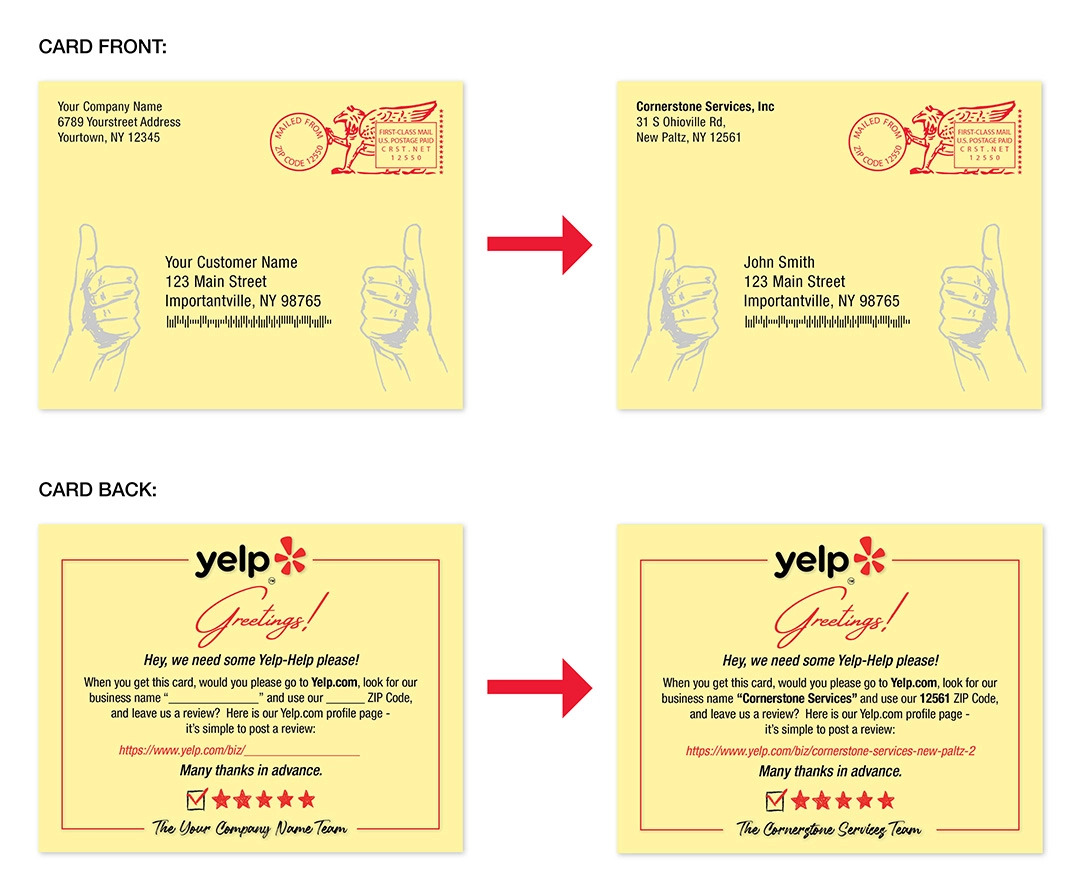
We just created a “Yelp-Help” postcard that would allow people to solicit reviews from their own customer list. This works for Google, Angi or other platforms. Certainly, this is working for us, and perhaps it will assist you in managing your web presence for the better.
If you’d like help with managing your web presence, getting a new website or anything direct mail related, please reach out to us at in**@**st.net or call (845) 255-5722. Thanks for reading and I hope this was useful.